I Round Fan 團扇
The history of the round fan, known as Tuánshàn (团扇), has a very long and rich history in China for more than 2000 years.
Originally made of feathers or bamboo, the round fan evolved into the “silk fan” during the Han Dynasty (206 BC – 220 AD). With the development of fine silk production, the circular silk fan emerged as a lightweight and visually appealing object. It was primarily used by the imperial family and high-ranking officials, earning the name Gōngshàn (宫扇) or “Palace Fan.” Frames were crafted from bamboo, bone, or ivory, while the covers were made of fine silk or gauze. Its smooth surface made it particularly suitable for painted decoration.
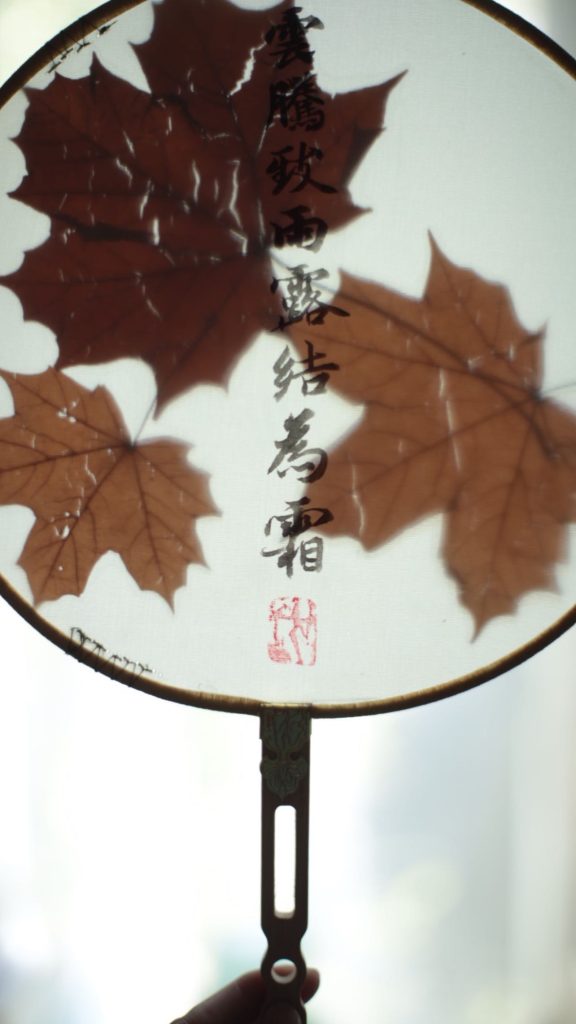
During the Tang (618–907) and Song (960–1279) Dynasties, the round fan transitioned from a fashion accessory to a legitimate medium for fine art.
Landscapes, birds-and-flowers, and delicate calligraphy were particularly popular as subject matters for the fan covers. Famous painters began treating the silk surface of the fan as a canvas. Because the space was limited and circular, it forced artists to develop a unique style of “intimate” composition. Their compact, circular format encouraged compositional innovation, requiring artists to rethink spatial balance within a confined, curved field.
Importantly, the fan was portable and intimate. Held in the hand, seen at close range, often exchanged socially— an ideal personal carrier of artistic expression.
The Song Dynasty was the undisputed “Golden Age” of the round fan, largely because the emperors themselves were obsessed with the format. It wasn’t just a trend; it was an imperial mandate that transformed the Tuánshàn (团扇) into a high-stakes test of artistic skill.
Emperor Huizong (r. 1100–1126) was perhaps the greatest royal patron of the arts in history. He famously used round fans to test the wit and “poetic imagination” of his court painters.
Instead of asking them to paint a mountain, he would give them a line of poetry. The artists had to fit a complex narrative into the small, circular silk space. One famous test used the line: “Bamboo grove hides a wine shop by the bridge.” Most artists painted the shop and the trees.
- The winner, however, painted only a lush bamboo forest with a single wine flag peeking out from the leaves.
By demanding this on a round fan, Huizong forced artists to master “the art of the empty space” (留白)
It was a Song tradition for the Emperor to write calligraphy or paint a small scene on a round fan and gift it to a high-ranking official as a sign of extreme favor. This created a “trickle-down” demand.
- Because the Emperor was constantly gifting fans, every artist in the Imperial Painting Academy (Hanlin Huayuan) was required to produce hundreds of high-quality “fan faces.”
- This created a massive collection of “album leaves” (circular paintings removed from their frames and saved in books), which is why we have so many surviving Song fan masterpieces today.
Its circular shape symbolises union, perfection and happiness, round fans provided highly sophisticated canvas for art and calligraphy, spreading from the prestigious court artists to the elite literati class, who loved the romantic canvas for expression.